
Hardware
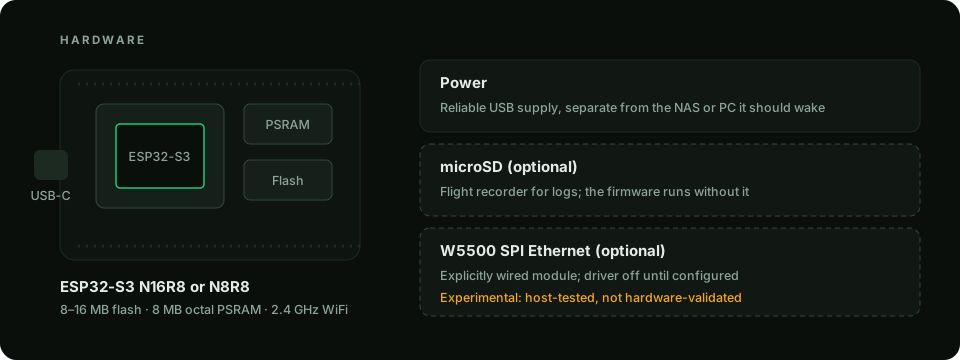
Firmware 3.x runs on an ESP32-S3 with 8 MB octal PSRAM and at least 8 MB of quad flash: N8R8 and N16R8 modules. One image serves both; a 16 MB board uses the first 8 MB.
Supported ESP32-S3 boards
| Board | Flash · PSRAM | Status |
|---|---|---|
| ESP32-S3-DevKitC-1 N16R8, ESP32-S3-WROOM-1/1U-N16R8 | 16 MB quad · 8 MB octal | Tested (reference board) |
| ESP32-S3-DevKitC-1 N8R8, ESP32-S3-WROOM-1/1U-N8R8 | 8 MB quad · 8 MB octal | Supported, same layout; not yet tested on 3.x |
| Freenove ESP32-S3-WROOM N8R8 / N16R8 | 8–16 MB · 8 MB octal | Supported; community-confirmed on earlier firmware |
| Seeed XIAO ESP32S3 (8 MB flash, 8 MB PSRAM) | 8 MB · 8 MB octal | Supported; community-confirmed on earlier firmware |
The module marking tells you the variant: N is the flash and R the PSRAM in MB. You need N8 or more and R8.
Not supported
- 4 MB flash (N4, N4R2, N4R8): Firmware 3.x needs 8 MB; these boards stay on the 2.x line.
- 2 MB quad PSRAM or no PSRAM (N8R2, N16R2, N8, N16): the image expects 8 MB octal PSRAM.
- Octal-flash modules (ESP32-S3-WROOM-2, N16R16V, N32R8V, N32R16V): the image uses quad flash.
- Other chips (ESP32, ESP32-S2, C3, C5, C6, H2, P4): the installers refuse anything that is not an ESP32-S3.
- YD-ESP32-S3 clones: reported not working (access point not visible, a board-level RF issue).
Requirements
| SoC | ESP32-S3 (dual core, 2.4 GHz WiFi) |
|---|---|
| Memory | At least 8 MB quad flash, 8 MB octal PSRAM (N8R8 or N16R8) |
| Power | Reliable USB supply, separate from the machines it should wake |
| Optional | microSD card for the log flight recorder |
Community reports for other ESP32-S3 boards are collected in docs/HARDWARE.md; please add yours with the Hardware report issue form.
W5500 Ethernet and cellular (experimental)
The standard 3.x image includes a driver for an explicitly wired W5500 SPI module: off until configured, explicit pins, DHCP or static IPv4, WiFi-first or Ethernet-first. It is host-tested only and not validated on real hardware; wire it as documented in docs/ETHERNET.md. A UART cellular modem with a SIM can be used as a primary or failover uplink, also off until configured and not yet tested with a real modem (docs/CELLULAR.md).
Single radio
The uplink and the access point share one 2.4 GHz radio and channel. After a roam to a different channel the device realigns the AP, which briefly interrupts AP clients.