
Selective Tailnet Service Gateway
Who it is for: anyone with a LAN device that must reach a specific service on a Tailscale or Headscale tailnet but cannot or should not run a Tailscale client.
Requirements
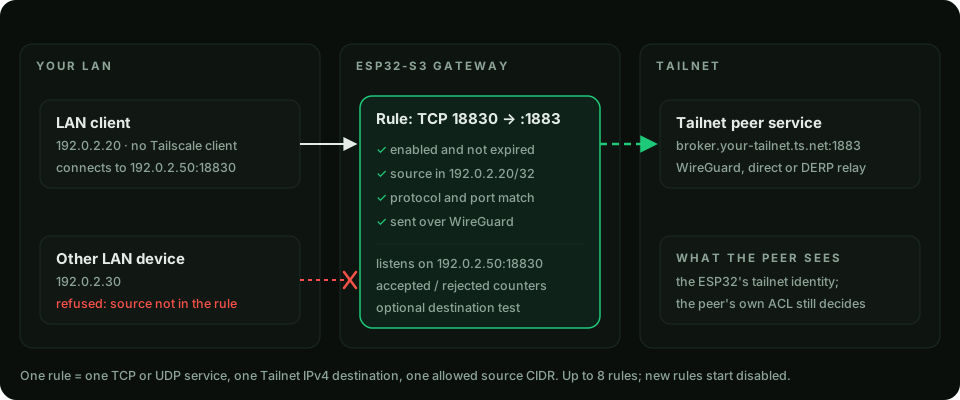
Example: a WiFi sensor at another home needs your MQTT broker, but cannot install Tailscale. Keep the sensor on its existing LAN; configure its broker address as the ESP32's LAN address and listen port. The gateway forwards that connection to the broker's Tailnet peer. Follow the two-home MQTT example.
- An ESP32 Tailnet Gateway joined to your WiFi and tailnet, with a fixed LAN address (DHCP reservation).
- A Tailnet peer running the service, whose ACL allows the ESP32's tailnet identity.
- The LAN client's address, ideally a single device (
/32).
Procedure
- Open Network → LAN → Tailnet and choose a template or the guided setup.
- Set protocol, listen port on the ESP32, Tailnet destination (
100.x.y.zor a MagicDNS name), destination port and allowed source. - Optionally set an expiry for temporary access.
- Press Test destination: the ESP32 performs one bounded TCP handshake with the service.
- Enable the rule and point the LAN client at
ESP-IP:listen-port.
Example
Protocol            TCP
Listen port         18830
Tailnet destination broker.your-tailnet.ts.net
Destination port    1883
Allowed source      192.0.2.20/32
Client connects to  192.0.2.50:18830
Verify
See the actual firmware interface before configuring your first rule.
- The rule card shows installed, then accepted packets and admitted replies when the client connects.
- Rejected counters grow when another device tries the port.
- Service watch (optional) re-checks periodically and can alert on change via ntfy or Home Assistant.
Common problems
- Destination test fails: the peer is offline, the port is closed or the peer ACL does not allow the ESP32.
- Installed but no traffic: the client uses the wrong address or port, or its address is outside the source CIDR.
- UDP shows no replies: UDP cannot be verified without an application reply; check the application itself.
Limits
IPv4 TCP/UDP, up to 8 rules, one Tailnet IPv4 destination per rule. It is a port forwarder, not transparent routing. Throughput depends on the microcontroller, radio/uplink and direct or DERP path. Use it for control and small services rather than bulk transfers.
Security
A source CIDR is not client identity: anyone who can use that address can use the service. The remote peer sees the ESP32's tailnet identity and its own ACL still decides. Protect the Web UI with a password. Rule commands over MQTT carry the rule's binding token so a stale command cannot act on a replaced rule.
Full guide: docs/SERVICE-GATEWAY.md.